Friday, May 31, 2013

Voter Registration

It was raining heavily but I thought this was an ideal time to go for my voter registration: I might not have to wait in line for long. So I went to the "Youth Club" just next to our ward office in Kathmandu, folding up my jeans, on a pair of rubber slippers, umbrella in hand. To my surprise, I was not the only creative soul to make this pragmatic decision. There were a few bunch. A woman from Butwal was being helped by an enthusiastic young staff to fill forms: there was a robust debate happening on her predicament that she needed to show evidence of migration (telephone/water bills) to be able to vote locally. There were several others, some looked like local folks that were just killing time watching activity at the place. The whole area was heavily guarded by riot police.

I was pleasantly surprised by my voter registration experience. The form was just about a half-page form with very relevant required informations to fill. And who would have expected- it asked your mother's name, even before your father's! To top this delight, the young women (who probably are temporarily hired election workers) were enthusiastic about helping me fill some areas which I had questions about. 

After filling the form, I was asked to go to a computer station where a gentleman took my form, took my picture and fingerprints. Then he asked where I was going to vote. I told him Gorkha. He plugged in my data and informed me that I will be voting at Lapsichaur Pra Bi. 

Here I come Baburam, a registered voter! Armed with a vote. Be prepared!

TB

One of my colleagues appeared unusually shaken today. A young nurse at the hospital who works with him was diagnosed with TB (tuberculosis). I was a little taken aback by his reaction. I had thought he was aware of an incredibly risky enviroment we work under. Obviously, I was wrong. 

Furthermore, to my surprise, he asked me how best to prevent acquiring TB. He has worked in Nepal much more than me and treated many more patients with TB, and in highest likelihood knows much more about TB than what an endocrinologist knows. So I told him, Daaktar saab, I may not be the best person to answer this, I don't recall treating a single patient with TB while doing my trainings in North America. But there were a handful patients that I have put in  isolation room as a precaution (all of them turned out not to have TB). These isolation rooms have a special setup to change air with certain frequency after filtering and sending out the air. You are required to wear special masks that are able to stop you from inhaling TB organisms. All the health care workers are required to have skin tests for TB every year. 

More than that, in our context, it is a disease of overcrowding: overcrowded homes with insufficient ventilation that help circulate the TB organisms in the air and make it easy for others to acquire. Recognizing this, Paul Farmer made it a point to go to his TB patients' homes in rural Haiti and help build new homes if they were of the mould that could predispose to TB. Our hospitals are certainly overcrowded and ICUs, where beds are crammed close, patients are coughing vigorously when a suction catheter is sent down their throat, is a place ripe for TB to plant in someone's lung. This time a victim was a young nurse amongst us (in highest likelihood she acquired infection at the ICU although she could have acquired the organisms from somewhere else too). 

He lamented, while we are running around with bare minimum pay taking care of the patients, shouldn't someone be thinking about these kind of precautions? 

The capacity of a place can be defined. How many people can this place serve effectively and safely, can be defined. But our hospitals do not do that exercise. We are guided by let's serve as many patients as we can. This sounds a nobel cause but we cannot ignore the risks. The risks to the patients and the risks to the providers. 

Wednesday, May 15, 2013

Kennel Vs. the Carton


We decided Kanchii, our dog, deserved a private shelter. So we invested a few thousand rupees to get a kennel, a sturdy metal structure with good ventilation and lavish space for small-framed Kanchii. But, to our dismay, Kanchii decided not to accept this metal structure as her private residence. What led her to arrive at this decision is completly unfathomable to us. Was she scared of the doors, of potential confinement, if someone closes the door on her- of losing her freedom? Did she not like the metal? Was the structure of this contraption hideous, lacking in grace and elegance to her aesthetics? We do not know. 


Whatever her rationale, she has never backtracked on this decision. She has stuck to her prized carton. We have lost hopes of her ever changing her mind such that the kennel now holds scraps. Does she ever doubt her decision? I ask myself. What gives her that certainty? 

Did she make a choice? And, if she did, where does she get this unyielding certitude from? For this more evolved mammal, who faces choices every step of the way, her certitude is indeed envy spawning. 

Tuesday, May 7, 2013

Lok and Loktantra

If the current fiasco of Lok Man Singh Karki is not sending you chills down the spine, it should. You do not need a deep factual analysis to know this man is no fit for the Commission for the Investigation of Abuse of Authority (CIAA). Two reasons of public record suffice: 

1. He was the chief secretary of the King's government at the time we were struggling to tranform this country into a republic. The commission formed to investigate the abuse of power during that movement found him guilty of "brutally suppressing the people´s movement and abusing his authority."

2. CIAA itself, based on the commision's report, had recommended against appointing this man to any public post. 

What we know is that the potbellied oligarchs of so-called four major political parties recommended this individual to lead the CIAA. The spineless government complied. Today in TV this is what we are seeing and hearing: 

- Mr. Sushil Koirala (oligarch from Nepali Congress): I think Mr. Karki should himself decide against taking the post as there has been much public outrage. I think the President should not appoint him as there has been a public outrage. (What do you yourself think, Mr. Koirala, of Mr. Karki BTW?)

- Mr. Madhav Kumar Nepal (oligarch from CPN UML): Mr. Karki should not be appointed. His party has submitted a letter to the President saying Mr. Karki should not be appointed. 

- Mr. Pushpa Kamal Dahal/Prachanda (oligarch from UCPN Maoist): UML proposed Mr. Karki's name. He has been recommended through a constitutional process. The president has no right to go against the recommendation. 

Feel free to draw the inferences.  

We have a government led by a chief justice. While appointing a person that has the power to investigate the abuse of authority, we are told this is the person that fits the best. Those who made the decision tell us they disagree with their decision and yet the decision should be made and enforced.

This is as loud as it needs to get to make us sleepless at night. That the aspiration of democracy is receding from our immediate reach. Imbecile might be the assessment these oligarchs make of us, outrage is the emotion we have at this moment. 

Friday, May 3, 2013

Coerced Social Responsibility

Patan Hospital is host to a government facility of telemedicine. This is housed in a small building amidst the crammed infrastructure of the hospital. It is a relatively elegant facility in sharp contrast to the clutter of the patient care areas. Floor is carpeted, windows have nice shades, partitions are orderly. Adorning this nice setup are several sleek computers of modern make and built. They stand atop reasonable quality furniture. Gracing this elegance are swivel chairs to go around!

This facility is linked with several district hospitals. They have also been setup with computers  apparently, where they can plug in patient information and get answers from specialists at the central level: in this case Patan Hospital. These are meant to support the doctors who are in the wild. To give them a back up of expertise where they find deficient. To keep them connected to the center (apparently everyone aspires to stay in the center). I presume this is one of the solutions someone has devised to confront the distressing difficulty of  staffing these remote facilities and getting them to stay. These doctors complain: we are alone, we don't get updated, we have no help. Here it is: type it away in this computer!

I am one of the physicians assigned to type out replies to these ghost messages that pop up in the computer screens: lifeless sentences that probably represent a soul in distress. However, I should confess I am not honored this exercise too often. There are few gentlemen from the Ministry of Health (MOH) who coordinate calling doctors to reply those messages. It depends on factors beyond my comprehension that determines their appetite to summon me. So I am a sporadic guest to this enterprise. When invited, I come to this bustling room. There are junior doctors downloading Hindi movies in the computer, some other people unknown to me glued to the Facebook. Each time I see new changes. Earlier there was a bed added to the room- inviting in the hassle of this public hospital! In a more recent visit, a partition had separated this bed converting it into a cozy enclave. Maybe someone is supposed to answer at night too. I do not know the purpose of the bed. The junior doctors apparently answer to phone calls from public. I hear them telling these callers: go take cetamol, don't worry too much. The gentleman from MOH scrambles as I arrive, to close down whatever he was surfing, and then opens up the software for me. Some of these guys have a decent dexterity with the computers, others are clumsy. Finally, after the screen is up, he tells me you can do this many today. I comply. There is a pattern to all the cases that I see. Perhaps doctors have a tendency to narrow down problems to their capabilities, most of these are COPDs, UTIs, Enteric fevers. I search for deviations to gather clues to the patient's problem. I try my best to give honest opinion from whatever information is available. One of my colleagues, who is also assigned to reply, asked the other day, "do you think this is helpful to them?" That is a question I ask myself too.

A few days ago, I received a call from one of the more active and enterprising MOH gentleman to schedule a video conference with a doctor at a remote district. Now you have video capability too? I agreed with a timetable for the afternoon. This time, the room welcomed a nice computer through which you could see and talk with the district folks! It was the same brand and type that I used to see at the VA hospital affiliated with my university at the US. You do have some spare change people, I told myself!

After some back and forth, the screen was up. They wheeled in a patient and the doctor showed up.  All this was happening because this doctor apparently persuaded all these folks. This doctor was a young lady. Her dress-up, accent made it amply clear she was from a city. Perhaps someone who had never before been to the villages. She stood out as an odd existence in the village crowd that had already gathered by now. A young city girl amidst the shabbiness of  village. What was she doing there?

She was one of the folks who have been mandated to serve in the remote government facilities. She went to one of the private medical colleges under the scholarship of the Ministry of Education. Having signed a bond to serve as ordered by the government, here she was fulfilling the requirements of her bond.

After our brief introduction, I asked her to tell me about the patient. This patient had breathing issues and diabetes. Blood sugars were out of control due to a medication being used to control the breathing problem. She told me what medications were available there to treat diabetes. She was doing the best possible with the available medications. I just agreed to her management plan. Then we moved on to a second patient. This patient had tuberculosis with pus in his chest. He had been treated at Kathmandu. A tube was placed in to drain the pus and he was sent home with tube in place. He came to the hospital requesting that the chest tube be taken out (he had been told that the tube should be taken out at this time). But the tube was still draining significant amount of fluid and if taken out, fluid would accumulate again causing breathing trouble. So this young lady doctor advised him that the tube should stay in place. However, he was not convinced so she decided to bring him up to the screen. I told the patient that his doctor was absolutely right, the tube should stay. He agreed. This doctor was doing a very capable job. I made this known to both of these patients.

Throughout all these interactions, I could not escape noticing a melancholy, anguish in this young doctor. She does not belong here, I told myself. Will she stay here once her two years is up? I do not know. Will the community benefit from her presence? I am sure they will having this capable person around. But is this arrangement just where a young woman is working in anguish by force of circumstances and rules to serve a community?

That is a complex question. However, the details of this arrangement has some brazen violation of a sense of justice which are worth discussing.

One of the most reasonable arguments I have heard in favor of forcefully sending doctors to serve the districts comes from a colleague of mine. He argues thus:

To become a doctor, you have received a lot from the society. Allowing a novice to send a painful pipe down the throat when some other competent person could have put it in with much less pain cannot be measured in terms of material interactions. It is immeasurable. How can that person learn to put a tube down the throat practising in this community and just walk away as if he had no responsibility to those who allowed that opportunity?

And it is a compelling argument which makes a lot of sense. It makes a case for moral responsibility towards the society in which one learns the creed of doctoring. But should this moral responsibility be forced is an entirely different question. One obvious question is how do you limit and identify the society upon which you have drawn your learning and to which you should be responsible. Is it the city of Kathmandu that you are obligated to if you went to medical school in Kathmandu and saw no patients from Dolpa during all of your medical school? Is it Dolpa if you went to medical school there? And this will not be an abstract exercise as we are debating Federalism. Our country will be divided into states where these distinctions of societies will start to appear. At the fundamental level, once we start tying a doctor to distinct societies, a basis for your society and my society will emerge. Do we want our doctors to have their obligations defined primarily by societies and geographies? Because equally compelling basis of ethical responsibilities are possible: serving the neediest of humanities (a doctor from Kathmandu might want to serve in Dolpa), serving those in prisons because you were born in a prison and have seen appaling situation of basic health care in prison, serving those with limb amputations from motor vehicle accidents because you yourself had both your legs amputated after an accident... There are innumerable compelling reasons that can be the moral basis of responsibility. Identifying one and coercing it will at the least be an exercise that is blind to these possibilities.

The only situation where I can see coercion to be tolerable is if we identify absence of doctors in these geographical areas as crisis and use it as a temporary measure while we start rigorously to build long-term measures. This coercion has to be universal: every doctors should be forced to do it and not cherry picked based on some other identified criteria.

Sadly, the coercion as it exists now is far from being universal. It is bigoted, unjust and outrageous. Let me be more specific. If you have gone to a private medical school under government scholarship, after competing in an exam at the national level, you have to serve in the remote areas for 2 years. However, if your parents have paid for your medical school, you have no such obligation. The bottom line: if you happen to be born in a family who can afford to pay for medical school you are waived of any need to serve in the remote areas. Lesson: choose your parents. You may argue, well, when you signed a bond accepting the scholarship you knew you had to serve in the remote areas, so why the whining now? You could have opted not to sign up for the scholarship. These are teens (17/18 year old kids) who are deciding about their prospect of going to medical schools. Do they really know what it is like going to remote areas? Even if they knew, where would some of these bright kids find millions of rupees to finance their wish to become a medical doctor? At that age, I would have signed any papers that would ensure my possibility of going to a medical school! Well, parents would know though? But the parents do not live these kids' adult lives, they change during 5 years of medical school, an adult does not necessarily live on the judgements and decisions of their parents. The bases of selective coercion is shaky at the least. Furthermore, there are few government medical schools where you pay minimal fees but you are not obligated to serve. It makes absolutely no sense. The government is eager to force others to fulfill this obligation but not from its own institutions. To conclude, the current arrangement is unfair. It is not universal. And it is discriminatory. Almost cringe worthy.

Lack of human health resources at the community level is an urgent issue. But the solutions that have been adopted are coercive and unjust. It seems like these people think that forcefully sending doctors to the primary health care centers and district hospitals will solve all the health care woes of this country. Are these half-hearted coerced doctors really needed here? Are there alternatives to these coercive measures that are more just?

I am certain there are. One such example exists at Patan Academy of Health Sciences (PAHS) known as Collaborative Scholarships. In this, communities identify potential candidates from their communities, send them for a competitive exam at PAHS, provide full-scholarship and bond them to come back to their communities to serve. It is still coercive but a simpler and fairer arrangement. You would know that this is where you will be returning back. You have lived here and have been educated here, so you know what to expect. In addition, studies have shown that health care workers who come from that community have higher chances of long-term retention. It appears to be a better choice. Collaborative Scholarship is just an example, we can imagine of multiple other possibilities to make this fairer. Moreover, this focus on doctors only is off-target to the actual health care needs. More than these doctors what we need are mid-level providers who can carry out the local health care needs. We hear very little about that. 

Is it a lack of imagination? Is it ruthlessness? Is it desperation that is driving these kinds of decisions? We talk about democracy and New Nepal. But are these our moral spheres where a certain callousness pervades our activities as if it is second nature to us. It is perhaps the same callousness that Nobel laureate and current National Cancer Institute director Harold Varmus was cadid enough to note and explicate about his Indian volunteer experience in The Art and Politics of Science. It is not something we can be proud of as a society. 

At the end of the conversation, I told this young doctor in English, "Daktar saab, you have been serving in a remote place, you should know that we are proud you." She paused, almost choking, and replied, "Thank you, Sir."

(Did I tell you how much I despise that word Sir- either in hierarchical use here in Nepal or a customer service use in the US?)

Saturday, April 27, 2013

Crumbling Buildings

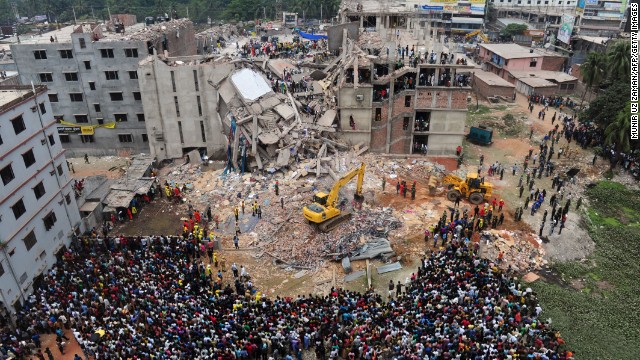
What must it be like: to have one's leg trapped underneath a heavy concrete beam, bones crushed, blood gushing out. Ceiling has fallen down and is pressing you to the floor. It is an enclosed space. Soundless. In the silence and darkness, you hear your pain, fear, hopelessness. That's it. That's the potential power of the event: to tell you what it is capable of.

This is exactly what some of our fellow human beings might be undergoing underneath the rubble of a collapsed building in Bangladesh. More than 300 people have died. Still, people are being pulled out alive from the rubble after days of the disaster.
Source: CNN (www.cnn.com)
What is outrageous is that the treachery of the event is actually traceable to controllable factors. It was avoidable. And that this is not an isolated event. These kinds of events have happened several times in the past: sometimes as fires swallowing up lives, sometimes as buildings crumbling down, crushing and burying lives.

To add to that outrage, the victims seem to be the vulnerable amongst us. These have been workers working under very poor conditions. They might be the sole breadwinner in the household. At the most recent event, many of them were women: mothers, sisters, daughters in the household. This selective involvement from these disasters further outrages us prodding us to question what leads to this? What factors might be responsible?

Is it greed? An unbridled greed to make profits at any costs. These garment factories account for 3/4th of Bangladeshi exports. They are businesses driven by profit. Profit in a competitive world where you want to produce quality products at the lowest prices. I can imagine of a cut-throat competition among these factory owners: to squeeze out their labor force, to maximize profits. Even then, would this businessman (or businesswoman) deliberately think about allowing people to die like this? I would imagine not. Then what goes in to create these crumbly buildings, inflammable buildings expedient at choking souls to death?

I can imagine of multiple things. A miniscule investment to make a building. An architect who is not very competent at designing buildings or is just careless. A contractor who shortchanges building materials to minimize his expenses. Building materials which are subpar. Working conditions where the building holds people and materials way beyond its capacity.

At each of these levels, do the responsbile people think of what the consequences could be if their responsibilites are shortchanged? Or have they been so habituated to doing it day-in and day-out that it is now just an abstract concept that escapes their daily activities.

In the immediate context, it is widely apparent that the incompetence and irresponsibility is killing lives and inflicting suffering. The main question is how can this be changed?

Thursday, April 25, 2013

Sajha Bus

Sajha Bus is a phenomenon here in Kathmandu these days. These green buses capable of accommodating more than 60 passenger stand out, just by their size, in this city where we have been used to being squeezed in Tempos and Microbuses.

So I decided to wait for one a few days back. It is an attractive option for my commute because I won't have to change vehicles; there is one route that goes from Gongabu to Lagankhel. Since they do not have many vehicles yet, I presume, I waited for nearly 45 minutes to get a ride. There were empty seats for a change! Having been used to accepting precocious teenagers' road rage filled rampage through the streets of Kathmandu as public transport, the calm cruise in Sajha Bus was indeed soothing- both to the bottoms and the mind. And having not to wrangle with a pre-pubertal kid to get the due change was a consolation too. I opened up a book for the commute and said to myself this is good!

Similar appears to be the feeling of many of my compatriots. When there was a hint of cartels (who have monopolized the public transport routes) growling, the response in the press and public comments were robust. There indeed seems to be a support for these green buses at the public level.

Caution is, however, advised in any ecstasies that frolick in our hearts at these shores. There is no paucity of grand initiatives in this country. The primary problem has been in completing those initiatives, maintaining the achievements and progressing over time. Sajha Yatayat has a history of existence in the past. Of success for a reasonably long time and a downfall. It is an institution of public-private partnership (a co-op). The downfall is largely credited to political meddling. It has been revived now again as a co-op with representatives from the government and other representatives from civil society who are well-known and respected in the society. They do offer us hope. But we still face a question, how is this different than the previous arrangement. Maybe there are certain conditions that are changed now that will prevent the institution from mismanagement of the past, I don't know.

Sajha Yatayat has set sight to transforming transport services of the country. The mission and vision that they have explicated are lofty. We do sincerely hope for the success of Sajha Bus. Firstly, because we want a trustworthy transport system. Secondly, and more importantly, to demonstrate a succesful  system that might be able to work at a national level to address many other developmental issues we have in our society. 

Sunday, April 14, 2013

2070

Wishes for a peaceful year ahead. Happy new year 2070 to all of you!

Saturday, April 13, 2013

Hypertension Article

We had written an article on the health system issues related to the increasing prevalence of hypertension in Nepal. It is published in World Health Organization SEARO's Regional Health Forum. You may access the article here.  


Thursday, March 14, 2013

Politics

The idea appeared completely crazy. But the turn of the events in past 24 hours have dictated us to accept a  new reality. We are now citizens of a country run by the chief justice of the supreme court. Our politicians have decided to give up the government. Bureaucrats are going to give us the election apparently. Some thoughts stand out in these dizzying turn of events, for those of us who until now thought that the talk about having CJ run the government for elections was a sham: 

1. Our politicians are a big risk takers (whether they calculate risks is an entirely different matter). 

2. Only the craziest of the ideas can bring our politicians together. 

3. We have lived in autocracy for a few months now, ruled by a few oligarchs (leaders of select few political parties), devoid of local level politics for several years; now we are going to be ruled by bureaucrats for a change. 

4. How is the politics going to look now? Power is now with the CJ. So what are our political parties going to fight for? Maybe because all of them are powerless, they will all concentrate on making good arguments, on winning arguments. Or maybe this is just a wishful thinking. Maybe they will feel the void and start attacking the CJ-led  government. 

5. The success of this government means that we will have an election that will give us an assembly that can start discussion on making a constitution (sounds familiar?). 

6. The failure of this government = no election (better not to imagine, but all too possible). 

7. Maybe crazy solutions work for our crazy politics. 

We hope so. 

Monday, March 11, 2013

A Story of Fire

Abhi Subedi has written a play "अग्नी को कथा " translated, "A Story of Fire" that plays at Aarohan Theater. It is apparently inspired by the inferno borne of his students' ire that lit his library and Department of English into flames. ".....this got me thinking," he said, talking about how "A Story of Fire" came into being. 

We were reminded of Professor Subedi's library and Department of English a few days ago. For us, it was shattered glasses that epitomized the pyre. 
Ours is a much distressing situation. A young woman in her very first pregnancy lost her life by the turn of events that probably took just a few seconds to start. She was having a Cesarean section to have her baby delivered. But she developed a rare reaction to the anesthetic agent. Who develops this rare reaction to this agent is unpredictable. Despite best efforts of the doctors involved, she died in a few days. It is chilling, how a young woman who might have been dreaming about holding her baby in her arms, maybe seeing the baby grow, maybe having more babies,....vanished along with her dreams. It is terrifying to imagine how the father, mother, husband, brother, sister of the woman might have felt learning that their daughter, wife, sister was there no more. 

As soon as the reaction happened a huge commotion started in the hospital. My colleagues describe there being more than a hundred angry people in the corridors of the hospital. Police was called in. They came in trucks with sticks and guns. They camped out at ICU. The hospital was like a war zone. When she died a few days later, the ire burst out, with young men using their helmets to smash the glasses that caught their sight. Some of these glasses were just next to sick patients, the arm swung into air throwing out shards of glasses, the rage numbing the senses as to be oblivious to another being's distressful predicament. Police apparently intervened, a bit later according to my colleagues, charging these young men with boots and batons. Eighteen were arrested per the rumors. 

1. What a distress
2. What a response

I can not reason out  an unexplainable, unpredictable response to a medication that is used routinely. At the same time, I can not reason out the violence borne in the setting of this distress. The violence achieved nothing, perhaps more distress to those taken to the jail, beaten with batons, those working in terror at the hospital. Had we tried instead to talk out  things, would that have helped? I don't know. Perhaps that is why Professor Subedi resorted to ".... this got me thinking" when flames engulfed his library and his department. I do not know. 

Tuesday, March 5, 2013

Universal Health Coverage

There are news of the government developing health insurance schemes for "universal health coverage". While the news is exciting, what has come out is not very reassuring in terms of ensuring "univeral health coverage." And at the same time, for those of us who work at the public sector, it is a far cry in need of much homework. Either we have been denied the grand efficiency of our government that has been hidden from us so far, or this is just a big talk, time will probably tell. But I had sent a response to an editorial published in Republica regarding the universal health coverage. They published it in the print form (I disagree with "perhaps health insurance would not even be necessary" inserted by the editor; please see the link above for my original comment). Here it is the published form: 


Saturday, March 2, 2013

Prayer Calls

At specific times and intervals, I surmise, loud voice emanates from loud speakers from the  mosque. It is rather musical; it does not bother me. I have heard male voices only, I guess the priest (if that is who sings these out) is always male. I do not know what the rules are for these prayer rituals. 

But it is clear, this voice, this sound, holds supreme in the public life of this city and perhaps nation. It is meant to be loud; audible to the citizens of this city, louder than the cacophony of this densely populated land. 

Do the citizens of this city value this sound? Or are they just used to it? Do they demand it? Is there any one who is bothered by it and wants it go away? These are some of the questions that come to mind. 

What of those people who are not religious? Or what of those people whose identity is not primarily religious? 

What is it like living in a daily dominance of religion? Even if it is a religion you are born to and ascribe to?  

Thursday, February 28, 2013

Basket Case

Today I got holed up all day in a hotel room. I arrived in Dhaka yesterday on a business meeting representing my institution. Meeting was scheduled to start today but, apparently, the opposition party called a strike. Earlier they were planning to take us to the university, where we are meeting, in an ambulance but that plan was cancelled today. The guy told us the political situtation was too unsafe to travel.

The street looks deserted. They have told us not to go outside the hotel so whatever I have peeked out from the window at the end of the hallway (the windows of the hotel rooms are blocked, by walls, not sure if it is a protection measure) probably does not represent the whole Dhaka on the day of this strike. Just a few moments ago there were loud sounds ringing out, sounded like gun shots. Not sure if they were aimed on somebody or were just warning shots or maybe burst out tires. I dared not to check it out. 

Bangladesh was called the "basket case" of Asia, a hopeless country. But it has pulled out of that reputation lately. It has done much better than other countries in the region in terms of several social indicators. The Economist says "Bangladesh combines economic disappointment with social progress.".. "The country has achieved some of the largest reductions in early deaths of infants, children and women in childbirth ever seen anywhere."

Dhaka airport's relative magnanimity just after coming from the chaos of Kathmandu's airport had been a welcome feeling. But today's deserted Dhaka offers no such solace. On the way to the hotel from the airport, a Nepali compatriot and a colleague at a different institution told me he feels better each time he comes to Dhaka: at least we are not the only country which is in a dismal shape, there are some worse than ours. But I am afraid he might be wrong. In it's shabby exterior, this country seems to be doing the right things. That can not be said with confidence in ours. But it indeed offers a consolation that things can be done even in most dismal of states. It is a consolation we terribly need working in the current conditions of Nepal. 

Sunday, February 3, 2013

Kanchii

Kanchii is making a gradual recovery. She is our dog. Every morning we take her out to take a dump. One morning, as we brought her back, a nasty black dog, which had sneaked into our compound through the open gate, lunged at her and sunk its sharp terrifying teeth. We did not realize the magnitude of the trauma until Kanchii's belly ballooned up on one side few days later. She gave up eating and camped in her box of carton where she normally sleeps. When she gave us no hope of spontaneous recovery, we called a vet. An enterprising stocky man, he came with his assistant. They grabbed Kanchii, shaved her side, made an incision in the skin which let out a gush of blood-mixed pus. She screamed through her strapped mouth all along. As I stroked her trying to comfort her, I found myself wondering if she knows we were hurting her to make her better. Does she know that? Or, maybe she is just profoundly aggrieved that their masters are inflicting pain on her. There is no way to know. But she has gotten back to wagging her tail and jumping at me as I come home now.

Why did that black dog enter our compound to bite Kanchii? Did he/she have grievances. Who knows what kind of rivalries run among these dogs? But how did she develop these grievances, if any? Kanchii lives in a closed compound. Her only exposure to the outside world is from the morning excursions where she empties her bowel and bladder. Was this black dog offended by Kanchii's morning rituals that she wanted to disembowel her? We know Kanchii as a meek animal. She functions as a door bell, barking primarily when there are people knocking at the gate. She keeps quiet as that person enters inside. How did she offend this black dog? It is hard to find answers. It just makes no sense. 

The world is witness to such black dog behavior in human society time and again. James Orbinski, a physician, who worked through Médecins Sans Frontières in Rwanda during the human carnage from Tutsi, Hutu conflict, writes in his book An Imperfect Offering: 

At one point, as I was driving through the city, a wild dog lunged at my open window. I hadn't seen it approaching as we slowed at a roundabout, and now I saw a pack of wild dogs tearing at a corpse (a dead human) in the grass by the roadside. They looked up at us as we drove by. The dogs were fat, bold and vicious. They were not moving from their mound of flesh. The dog that had lunged at our four-by-four returned to its pack, growling, baring its white teeth, and held me in its stare. 

It is a scene of evil hidden in human run amok. Orbinski who has witnessed it first hand tells us, he has seen humans even worse than the black dog. He writes in the same book: 

....She said that she had escaped being killed by the interahamwe. "My mother hid me in the latrine. I saw through the hole. I watched them hit her with machetes. The men were angry and strong. I watched my mother's arm fall into my father's blood on the floor and I cried without noise in the toilet." I listened to her and watched her lips quiver as her words came at a slow, staccato tempo. I watched her brown eyes look away as tears dropped to her cheeks and I could not stop my own. 

At that moment, I felt both despair and rage. Despair that she knew intimately our capacity for the most extreme rational cruelty; that she was alone. Animals could never do this. Animals can be brutal, but only humans can be rationally cruel. We can choose anything, we can be anything, we can get used to anything, I thought. Only humans can be evil. Only humans can make this choice. I felt my heart pounding and I wanted a gun. I wanted to kill the men who had done this to her. I wanted to pull the trigger again and again and again. My heart was racing; I was fighting my tears, gasping for air, for freshness, for something other than this. Then Eli clasped my arm with his strong hands. I felt an overpowering despair for the little girl, for myself, for all of us-- that we can be alone, trapped in our passions, in our reasons, in our minds, in our politics, that I and those men could be so angry and strong. 

Be it in an African nation, far away from where we live, it incites an indescribable torment. But we have our own share of such images and such despair. I am haunted by an image of charred body, supine in the ground with burnt arms flexed and skull bare. A result of inferno borne of rage from ethnic hatred in Tarai. This was an image I saw on TV, during the Madhesh unrest. An anguish looped incessantly in my heart, "How can a human do this to another?" Recently, I searched for that image on the Internet; maybe I could come to terms with it, seeing it again, I wanted to find a closing. But I could not find that image. Did I imagine it? Or have we forgotten? I do not know. 

But the violence we have gone through in Nepal has left its legacy. In our daily interactions, I find the remnants of that cruelty and violence it a little subtle ways: in our recklessness, greed, indifference and lies. It is disquieting.  

Friday, February 1, 2013

How do we save our honor?


Hospital that I work at runs private clinics. These are clinics where patients pay substantially larger sum of money than the general clinics to see a doctor. They are given a private room, attention from a fully qualified doctor and a personalized setup. All the revenues generated from this goes to the hospital’s charity which funds the cost for patients who cannot afford  care. I was asked to join this clinic. I will be spending 2 hours a week in these clinics. It started last week.

As I was waiting for my patient to come in, a man peeked in. He asked me if I would be able to see his neonate because the pediatrician had not arrived yet. The child was not eating well, he said. I am also a doctor, he declared. He said, he could have taken his child to the emergency room but he was worried about getting infection from that chaos. I agreed. But I told him I am an endocrinologist, I have no skills to evaluate or treat an ill child more than what he probably knows. In a typical pushy manner that I encounter in general clinics from people with some authority and recognition but perhaps also a desperate father bothered by child’s illness, he perseverated if I could still see his child. I said no.

The character in J M Coetzee’s book Diary of a Bad Year deliberates about the US administration’s involvement in torture of captured terror suspects:

Their shamelessness is quite extraordinary. Their denials are less than half-hearted. The distinction their hired lawyers draw between torture and coercion is patently insincere, pro forma. In the new dispensation we have created, they implicitly say, the old powers of shame have been abolished. Whatever abhorrence you may feel counts for nothing. You cannot touch us, we are too powerful. 

Demosthenes: Whereas the slave fears only pain, what the free man fears most is shame. If we grant the truth of what the New Yorker claims, then the issue for individual Americans becomes a moral one: how, in the face of this shame to which I am subjected, do I behave? How do I save my honour?

We doctors also work in a shame. We are scared to take our own child to where we treat other’s children. I cannot imagine of asking my parents to wait in line at our hospital to get a ticket to see a doctor at the general clinic, I would have failed as a son if that situation comes.

The question then becomes glaring to us: How, in the face of this shame to which we are subjected, do we behave? How do we save our honor? 

Saturday, January 26, 2013

Rewards in Medicine

As I was going through some of my stuff the other day, I came across this medal. 

On the last clinic day of my fellowship, as I just finished seeing my last patient for the day, our clinic secretary approached me to tell that one of my patients was waiting outside to see me. I stepped outside to the lobby to meet this patient. She was a patient very well-known to me. In her hand, she had a gift bag. From that bag, she pulled out a medal. It was a marathon finisher medal. She told me, "I got this specifically for you after I finished the marathon because you made me able to do this." 

Initially, she came to us, referred by her primary care doctor, for overactive thyroid gland. A woman in her 40s, she was tense and irritable. I vividly recall her sighing constantly while I was trying to get a detailed information about her problem, as if she was bothered by my questions. I gathered she was an avid runner, physically very active. With the overactive thyroid, she was not feeling herself. She was very vague about what exactly was happening. As I was prodding her to get text book descriptions of symptoms associated with overactive thyroid, she was half-heartedly throwing out statements. I went through her laboratory investigations. It was a classical overactive thyroid disease called Graves' disease. I drew a picture of pituitary and thyroid in a piece of paper and started explaining her what was happening to her, a routine for me for this kind of disease. After that I told her that we had three options to treat: medications, radioactive iodine treatment and surgery. We discussed about each of them. She was interested to know what will make her feel better the soonest. I told her medications would be able to do that. But they would not cure the disease. We have to constantly monitor labs and adjust medication dose because the disease activity fluctuates. So it might be a reasonable option to treat the symptoms immediately but generally we do a definitive treatment: most commonly, destroy the gland with radioactive iodine or rarely, remove the thyroid gland surgically and replace thyroid hormone which is a much steadier treatment modality. She was desperate to get symptoms controlled, she opted to go for the medication.

She was one of my needy patients. After each test result, we would have a lengthy conversation on what it meant and what she should do. She was feeling much better with the medication but was worried about the return of the symptoms in the future. At a point, she started questioning if she should actually have radioactive iodine treatment. 

In radioactive iodine treatment, radioactive isotope of iodine is given to the patient. Since the thyroid gland preferentially and avidly takes iodine, it gets concentrated primarily in thyroid. It emits radiation there which destroys the thyroid gland. It is extremely safe. Resulting thyroid hormone deficiency is easy to replace; once the proper dose is determined there is not much fluctuation and does not require frequent monitoring. 

Her main concern was how long it would take for the radioactive iodine to completely destroy the thyroid gland. Because until it is completely destroyed, there may be fluctuation of hormone levels and she was scared about having the previous symptoms. She asked me, how long will it take before hormone levels stabilize? Will it affect her ability to do physical activities? Being active was very important to her. She was planning a marathon. Will she be able to do it? I explained to her the response is very variable and generally takes months. It's hard to predict. We discussed it at length. By this time, we had established a good rapport and trust. Stepping the boundary of objective discussion, almost patronizingly, I told her, it will be OK, because there are many patients who have this without much problem. She agreed to have radioactive iodine treatment, she had a very good response, and she reached steady thyroid hormone dose smoothly. She was able to complete her much planned marathon.

For an endocrinologist, it was a routine disease. It was a routine treatment. It was a routine interaction. 

But here she was in the lobby of my clinic with a gift bag, marathon finisher medal and a gift card. She must have asked my clinic staff when my last clinic day was. She wanted to make it special. I was much overwhelmed. I thanked her and gave her a hug. Later I emailed her: 

Dear _(first name),

I was profoundly moved by your visit and thoughtful gift today. Of all the gifts and awards I have received in my professional life, this is the one I am going to cherish the most. I hope I can live up to the standards you have attributed me and be of service to the ones with illnesses and ailments.

Thank you,
My first name.

It was a strong lesson for me, how a routine mundane illness can be a gargantuan issue in the patient's life. These days, it distresses me when my colleagues speak of interesting case. I tend to think there is nothing interesting about these illnesses. They are irksome at the least and sinister at worst. I have yet to find a patient who is tickled by an interesting illness. 

Furthermore, this humbles me to realize the special platform the creed of doctoring offers. Each patient who comes to us with suffering offers us an opportunity to help her. A reward of incomparable substance. We are offered an opportunity to reap rewards with each patient. It just seems so cruel to brush off any of these patients, ignore and neglect any of these patients. 


Thursday, January 17, 2013

Imploring Amnesia

Everyday, we are served a sight of our statesmen exiting important places: President House, party offices, Mr. Sushil Koirala's house. These are men, with protuberant bellies mostly. From the push and pull of reporters, we are demanded to infer that these men are important people. What they say matter.

But we find ourselves lost to their magniloquence most of the times. Rather, I find myself appreciating, many a times, their sleek attire, lustrous cars of diverse makes and models; on the eminence granted by security personnel clad in neat dark suits running alongside the moving vehicle. How do these people finance such oppulence? In these dusty roads, filth, how do they keep themselves so neat? We wonder. Indeed, our proletarians have come a long way. In their splendor we seek our dreams. Forget about what they have to say!

However, not all is lost to our ears. Some of the recent events are incapable of being buried in  the platitude of our political oratory.

1. A Nepali colonel Kumar Lama was detained in UK. He is charged with intentionally "inflicting severe pain or suffering" as a public official, says BBC. Our government has objected to the detention.

2. A Nepali journalist Dekendra Raj Thapa was killed in 2004 by Maoists. Thanks to persistence of the journalists in seeking justice, recently the perpetrators of the crime have been arrested by the police. They have apparently confessed to burying Mr. Thapa alive. Our Prime Minister has tried to stop the trial. He argues, if this process goes forward it will derail the peace process. We should forget what happened in the war. 

What are we to make of all of these? 

We are told, it is wrong to seek justice when someone has been tortured and buried alive. We are told, we should get our colonel back who has been arrested for war crimes. This is what it has come to: these are the moral battles of our government, of our politicians. 

We had seen it coming all along. They told us, it's okay to kill for a larger purpose. We were told it was necessary to let barbaric men pin a man to a tree and torture him till his soul scrammed out of the battered body, in order to achieve justice and prosperity for all the downtrodden. Bombing a bus and burning 39 people alive, to kill 3 army personnel, was deemed a possible error in war. When our teenage girls and women were raped and killed by our tax-paid army, we were told that happens in war and that our army was fighting to protect us. 

In more than a decade of blood-bath, we were visited by the darkest of the evils. Our children's innocence had been violated by the daily display of heinous atrocities in our news media. Numbed by the horror, we were speechless, motionless. 

Now we are told, we need to forget that time. All those were done for a purpose. We have agreed to move forward. In strong rhetorical terms we are told, our only way is way forward. 

But we ask, where are we on that purpose? What was that purpose anyways?

Mr. Prime Minister and Mr/Mrs/Ms Politicians, we might have been speechless but our memory teems with every detail of the horror that happened in that time. We beg you not to try to trample our basic intelligence and human character. The fact is clear: now that your phantasmagorical philosophies are going down the drain, you have to face the deeds of your past. You have served us void where you had told us gold would be delivered. Now that we are empty handed, we ask you why you made us witnesses to the darkness inside you?

Some of us, unfortunately, are not blessed with amnesia to the horror of violence as you seem to be endowed with. Whatever the pragmatic way out of this mess might be, we have learned a solid truth about loud voices that say violence is a justified force. Even now we hear some of you saying you are ready to take up arms once again: please know, we have been disillusioned.   

Tuesday, January 15, 2013

Interrupt after 17 seconds

Few weeks ago I got a distinct privilege of sitting at a viva station in the exam for first year medical students at our medical school. These are brand new students. Fresh out of 10+2, they have started their arduous journey to become doctors. Enthusiasm is palpable. Their trepidation is apparent: it must have been just few weeks or months that they have been introduced to esoteric terminologies and concepts of medicine. Furthermore, our school places a big emphasis on social responsibility and critical thinking. They must be torn out of their minds in this bewildering world where concepts are being played around them, teasing them, taunting them and daring them. 

I had two questions to ask : one was about communication with patients and another about a concept in patient care. One answer by three of the twenty six students that I talked to intrigued me. They said, "You should interrupt patients after 17 seconds if they keep talking." It did not make a sense to me. But three students are saying the same thing. It has been a while since I last saw one of these History and Physical Examination cook books. Have they come up with new stuff? 

So I decided to pull one out of library shelf and take a look. What they meant was, on an average, physicians interrupt patients after so many seconds. Poor students, who probably have slept only a few hours trying to cover all the bases for next day's exam, got it upside down!

These students are just starting, the mistake is almost cute. But you hope they don't have to go through this confusion in some of the basic stuff of being a doctor. 

These are the kind of things they should be learning by seeing it done. There is no good substitute than the example of deed. Let's talk an example: 

Being a diligent student at the medical school, text book concepts about good patient care was not totally unknown to me. Concepts of empathy, respect did make a sense. But my real education on those issues was seeing the doctors do it. On my first day of residency rotation, a senior neurologist helped an elderly patient take off her socks to do ankle and plantar reflexes. After being done, he put back the socks, helped her with the shoes and walker before she could sit down to talk about her problems. I was taken aback. Does a senior doctor do such things:Take out a person's socks and put them back as if he is a helper in an elderly home? But as the residency days passed, it became obvious that it was a basic courtesy: helping an elderly person. Subsequent days have offered many more occasions to see such deeds that makes me feel privileged.

Our health care system should be able to provide such an opportunity for our students too. A clinical care area where a patient will be treated with dignity and respect will demand the same from a novice student who has all the good intentions of being a superior doctor. Patient care where patient's interests hold supreme will indeed prime the malleable minds of our young doctors to hold up to that standard. Clinical care is where all the real action of education starts, in my opinion. There are no stronger lessons than seeing things being done. Concepts are abstract, they belong to the realm of imagination. We deal with breathing lives, deeds do matter. 

Unfortunately, it is a sad realization, our institutions do not currently have much emphasis on improving patient care. Our educationists are quite fired up when it comes to talking big syndromes in class rooms but when it comes to taking care of small details in patient care (which carry a huge implication for patient outcomes), they are listless, absent and sometimes abhorrent. You will see sleek classrooms in many of these institutions, but they will have crammed up all their patients in a space where breathing is difficult. This needs to change. It is not good. 

Thursday, January 3, 2013

Access and Quality

In the 1960s, China saw a phenomenon of "barefoot doctors." Named after barefoot farmers in southern China who worked at the paddy fields in a commune and also practiced medicine, these were farmers who underwent short-term training of three months to a year and delivered basic health services to the community.  This offered decentralized basic health care services which focused on prevention and was sustained locally. 

Despite quite a low per capita income, China achieved infant mortality rates comparable to developed nations by the 1980s. 
Although, there were concomitant social and economic progresses, many people credit improved access to basic health services provided by barefoot doctors for this phenomenal reduction in infant mortality rate. Carl Taylor writes in Reaching Health for All: 

      "The Chinese experience shows that with equitable distribution even the simplest
       and lowest-cost health measures can have great impact. It is more important that
       care at community level be readily available to all with no barriers of cost or 
       social constraints than that it be of the highest quality...."

This should be an illuminating lesson for our policy makers who seem so hung up on coercing doctors to stay in remote areas, as if the presence alone of half-hearted doctors in these desperate places is going to solve all our health woes. This experience suggests that what we actually need is ensuring unimpeded access to basic health services. And this is best provided by locals who receive short-term targeted basic healthcare delivery training. 

While Mr. Taylor emphasizes access over getting obsessed with high quality care at community level, it does not mean that quality of care is a dispensable luxury. As much as our community suffers from access issues, our so called tertiary care centers suffer from quality issues. And, I think, lack of quality in these higher centers is as much of an issue as access is for the communities. 

Few days ago, my father asked if I knew anyone at Tribuhuwan University Teaching Hospital (TUTH). One of my villagers had brought his daughter to the emergency room there and knowing that I was around, he was trying to check with my father if I could put in some words to the doctors in that hospital. First off, I do not know many people at TUTH. Secondly, why should one seek relations when there may be tens of other patients who might be going through the same process of patient care? Still, I half-heartedly called one of my friends at TUTH, just to satisfy my father, and asked him to see if he could ask a resident in the emergency room to check on that particular patient. 

Two days later, when I arrived home in the evening, I found the patient, her father and her cousin camped at my living room. They had left the hospital against medical advise, one of the notorious LAMAs (Left Against Medical Advice). Frustrated, father explained his dissatisfaction thus: 

They were in the emergency room, a place akin to goat shed (in his own words). Nobody seemed to know what was going on with her. Students poked on her eight times drawing tube after tubes of blood as if the sole purpose of her presence was to offer a  practice opportunity for these students. They were told that she needed blood and she needed to be admitted. Somebody told she would need a bone marrow biopsy; another person told she did not. After less than a 1/2 of the first unit of blood was transfused, the catheter clogged and blood was not transfused for several more hours. When asked why the catheter got clogged and blood was not running, they were told an inexperienced person had put in a catheter. So what is the purpose of staying in the hospital, if she is not getting the treatment and is a subject of experimentation every step of the way? That's why we left the hospital. 

I flipped through a sheaf of medical documents. She had gone there with a feeling of weakness and shortness of breath. During evaluation, her hemoglobin was found to be quite low at 6 g/dL (normally it is around 12). All other testings were normal. 

I can imagine of a rich academic discussion that might have happened amongst the doctors participating in her care. A senior doctor must have asked, "What's the cause of isolated anemia with normal WBCs and Platelets?" An apt among the herd of the learners must have purged out a list of differential diagnosis astonishing the less well-read ones. To that list, the senior doctor must have added some sharp criticisms or comments. Everyone must have been quite appeased by such a rigorous academic exercise, ready for a round of momos, tired  by the effort of recalling data that are normally transcribed in the books. 

But what of the patient? 

She left the hospital with hemoglobin of 6 g/dL. This condition is perhaps not acutely life-threatening, but a teenage girl leaving a hospital in critical condition is a big failure of the system. We tend to blame patients for these kind of failures: LAMA is a patient responsibility, what can a doctor do? We say. But if this person was my daughter, I would have done the same. Perhaps piqued by such repetitive lame arguments, Paul Farmer, a doctor of deeds for the neediest, had a simple thing to say about such non-compliant patients: 

      "The only non-compliant people are physicians. If the patient doesn't get better, it's your
       own fault. Fix it." (In: Mountain Beyond Mountains)

Dr. Farmer is talking about a patient who is not getting better despite some efforts and is asking for increased effort. But we are talking about owning some responsibility for at least critical and acute care. 

Barefoot doctors seem like an attractive option for basic healthcare in our communities but it does not justify footless doctors in our higher care centers. More than that, apathetic hospital administration that leaves patient care to the devices of mob dynamics needs to realize that its somnolence is a reason for much agony. 

Saturday, December 29, 2012

Image, Event

October of this year, we visited the Norman Rockwell Museum in Stockbridge, Massachusetts. This painting by Howard Pyle gripped my attention. With a sheer force, it thrust my imagination to the horror of the situation. At arm's length, these men are facing each other. Another man of flesh and blood. Horses neighing, alarmed by the clamor, perhaps injured already by whips of terrified master and sharp bayonets of master's enemies. At this proximity, these men perhaps see their enemies' eyes, face. How do they lift their sharp swords or pointed bayonets and shove it into another man's throat or chest or belly? Whoever plants the sword to another's chest must be numb with an overwhelming force. The stabbed one must be terrified as the darkness replaces the light of life. Those who have not yet planted a sword or been stabbed must be scared, terrified, uncertain. This is a feeling of undescribable anguish, horror and terror. 

It is an image that incites an imagination about the event. 

In the past few days, the world has been subjected to an event, that incites an even terrifying image of horror. A young woman in Delhi is lured into a bus along with her boyfriend. Six men assault them with iron rods, rape the girl, and throw them out of the bus stripped naked and unconscious. We learn today that the girl died.  

Who are these men? These six men. How did they decide they will take a bus down the road, lure a woman, rape her, and kill her? What must have happened in that bus? Six lustful evils preying upon a woman. There must have been shrieks, cries, moans. How did these evils' eyes look when they impaled the  helpless woman's belly with an iron rod? This is an image of horror, pure horror. 

Thursday, December 27, 2012

Faulty Analysis

Republica had published an editorial regarding failure rates of medical students at Nepal Medical Council (NMC)'s licensing examination. A little irked by shallow analysis I had sent a tad sharp comment online. They decided to give it a space on print edition the next day: 


The licensing exam failure rate of students who went to medical schools in certain countries, namely, China, Russia, is high. I have heard the argument of requiring students planning medical school overseas pass Kathmandu University's medical entrance examination tests, at varied platforms. It might add some safety by helping select qualified individuals, especially if the exam is standardized to test qualities that determine a good doctor (and not just knowledge, as is done now). However, even if this has any significance, it will perhaps be minuscule. The main action will be in what the student gets in her 5 years of medical school. Until we think about assuring a basic minimal quality in those 5 years, any other efforts will be trials with high chances of failure. 

But what we can do immediately is build mechanisms to rehabilitate these individuals who are doing poorly in the licensing exams. For example, we could require anyone who fails twice consecutively to do 2 years of rotating internships at selected academic institutions in Nepal before they can apply for the license. All who fail, either they have done medical school in Nepal or overseas, should be treated the same. This exercise of demonizing students from select countries is a form of bigotry that lumps all grades of students together. It is unfair to diligent students from those places. And it is ultimately going to serve no good. Even these poorly-trained students  have already spent a fortune and ripe youth at these institutions. They are ultimately an asset to health manpower-deprived country. We need to find ways to remedy their deficiencies and give them a proper place where they can  contribute to the care of sick and infirm of this nation.   

Wednesday, December 26, 2012

A Squatter Settlement

There is a squatter settlement in Maharajgunj, just behind the staff quarter of Institute of Medicine. On my way to and from work, I sometimes take the way through this settlement. There is something about this settlement that gives a positive vibe. 

It is a crowded place. In a narrow strip of sharply inclining land, it is a motley of shanty houses and few sturdier ones separated by tight alleys. A loud whisper is perhaps audible to the settler's neighbor. Wandering chickens and ducks in these alleys, I am sure, find treats at several of the owner's neighbors. 

But this settlement seems cool about the sardined living conditions. In these narrow empty spaces, which are neatly stone-paved, children are jovially playing badminton and hoola hoops. Adult males are engrossed in several groups of carrom board games, back from work and winding down or unemployed and killing time, I do not know. 

Furthermore, the organization of the limited space is quite impressive. All the alleys are paved with concrete. In the slope, there are neat concrete steps in the alleys gyrating down the hill. At the bottom of the settlement, there is a remnant of river, which now flows with sewage composed primarily of  nearby city dwellers' excrement. They have managed to cover the river completely with concrete structure so that the filth is hidden. The only evidence of that horror is the open river, just before the squatter settlement starts. This open disgust snakes up the non-squatters settlement, malodorous and ugly. It seems like no one cares in those turfs. 
 

Compared to the non-squatters, somehow, these people appear to have been able to do something of common good. It is obvious that they have been able to organize things around them. These narrow alleys are clean, they have common space to play, a big water tank with a tap stands upright at about the center of the settlement that everyone can come to collect water, a filthy open sewage is covered throughout the settlement. 

How have they been able to do it? Did some donor do it for them? I doubt it. Are they unified by common predicament that is driving them to work together for common good? Are they unified at all? If so, what is bringing them together? It does look like development. And what does it tell about our constant whining about the lack of funds for development in our communities?

These are some of the questions which a physician who deals with rotten/rotting/degenerating/broken body is perhaps ill-equipped to answer. But the distinction from indifferent settlements surrounding this squatter settlement can not escape his attention.